

Corrosion testing and salt fog testing
How long can your products, components, and materials withstand salt, moisture, and harsh environments? At our testing laboratory in Hamburg, we conduct corrosion testing on parts, components, metals, and coatings - ranging from standard salt spray tests in accordance with DIN EN ISO 9227 to custom tests. You’ll receive reliable results for qualification, development, and certification.
Corrosion Testing in the Lab: How Durable Are Your Products?
Corrosion occurs, when metals and alloys react with moisture, salt, and oxygen in the environment. The rate and type of corrosion vary depending on the environment - whether it’s a marine climate, an industrial atmosphere, or road traffic. These corrosion mechanisms proceed particularly rapidly on the high seas, near the coast, or due to road salt in traffic. Damage to housings, connectors, or coating systems then leads to failures and customer complaints.
A corrosion test in the laboratory simulates these conditions under defined parameters and accelerates the process. This allows you to test the corrosion resistance of materials and the corrosion protection provided by coatings and finishes before a product goes into mass production. Typical applications include qualification tests for customers and regulatory approvals, as well as comparative tests conducted during the development process - for example, when switching to a new material or coating system.
Corrosion testing is standard practice in many industries: the automotive industry, aviation, shipbuilding, and defense, as well as in electronics and rail transportation.
Salt Spray Test in Accordance with DIN EN ISO 9227
The salt spray test - also known as salt fog test, or salt spray examination - is the most widely used method for corrosion testing. It quickly reveals how the corrosion resistance and corrosion protection of various materials differ. A salt solution is finely sprayed into a test chamber. The specimens are exposed to the salt spray for a specified test duration, at a constant temperature and under controlled pH conditions. Depending on the requirements, we conduct the salt spray test as either an NSS or AASS test.
NSS Test: Neutral Salt Spray
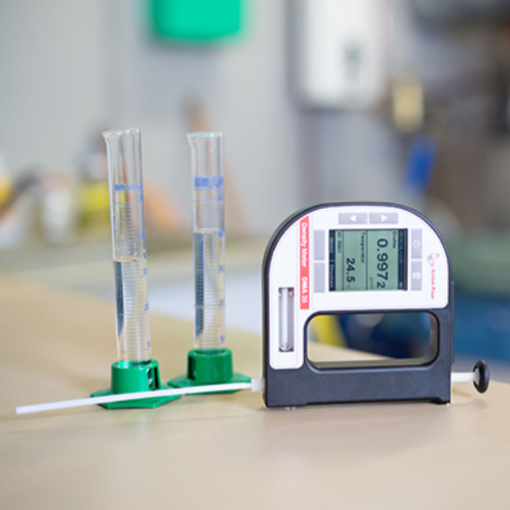
In the NSS (Neutral Salt Spray) test according to DIN EN ISO 9227, the test solution consists of sodium chloride in water with a salt concentration of 50 g/l. The pH value is in the neutral range of 6.5 to 7.2, and the temperature in the test chamber is 35 °C. The neutral salt spray test is suitable for metals, metallic coatings, and organic coatings. Comparable test conditions are described in ASTM B117; the salt spray test according to ASTM B117 is frequently required in U.S. specifications.
AASS Test: Acetic Acid Salt Spray Test
In the AASS (Acetic Acid Salt Spray) test, the salt solution is acidified with acetic acid to a pH of 3.1 to 3.3. The AASS test is therefore significantly more aggressive than the NSS test and is primarily used for decorative coatings, such as copper-nickel-chromium or nickel-chromium layers, as well as for anodized aluminum.
Cyclic salt spray testing and special test conditions
In addition to endurance testing, we conduct cyclic salt spray tests, for example in accordance with DIN EN IEC 60068-2-52 (Test Kb). These tests alternate between salt spray, humid, and dry phases, more accurately simulating real-world environmental conditions. We can also vary the type of test salt used to meet specific requirements. We work with you to define test parameters - such as test duration, salt content, and number of cycles - in accordance with standards or customer specifications.
What products, materials, and coatings we test
- Parts and components made of steel, aluminum, and other metals
- Housings, connectors, and electronic assemblies
- Coatings, paints, and varnishes, as well as metallic coatings
- Comparison of corrosion protection systems and coating systems
- Materials in the development phase, e.g., when comparing two coatings in a salt spray test
For manufacturers in the automotive, aerospace, shipbuilding, and defense industries, salt spray testing is often an integral part of the qualification process.
Analysis and Evaluation of the Results
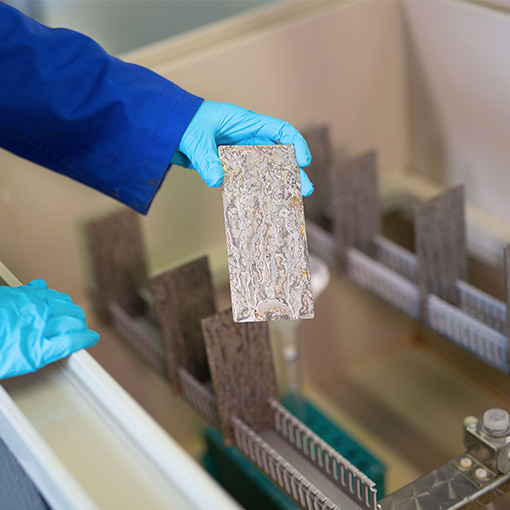
The evaluation is based on standards and customer specifications. It may include a visual inspection and assessment of corrosion damage, for example, in accordance with DIN EN ISO 4628-2 (blister severity). For coatings, paints, and varnishes in particular, we use additional evaluation methods, such as scoring (DIN EN ISO 17872) or cross-hatching (DIN EN ISO 2409), as well as other methods as requested by the customer.
We document all results of the corrosion testing in a test report that includes test conditions, test duration, photographic documentation and evaluation.
Overview of standards and test methods
| Standard | Testing procedures |
|---|---|
| DIN EN ISO 9227 | Corrosion Testing in Artificial Atmospheres—Salt Spray Tests (NSS, AASS); Basic Standard for Salt Spray Testing |
| ASTM B117 | Standard Practice for Operating Salt Spray (Fog) Apparatus |
| DIN EN 60068-2-11 | Ka Test: Salt Spray |
| DIN EN IEC 60068-2-52 | Test Kb: Salt Spray, Cyclic |
| MIL-STD-810 | Salt Fog |
| RTCA DO-160 | Salt Fog |
| DNV-CG-0339 | Salt Mist Test |
| UL 2129 | Salt Spray Corrosion Test |
| DIN EN ISO 6270-2 | Coating Materials - Determination of Resistance to Moisture, Part 2: Condensation |
Additional standards and factory specifications are available upon request.
The Process of Your Corrosion Test at Treo
1. Inquiry: You specify the product, parts, or components, the standard or specification, and the desired test duration.
2. Test Planning: We determine the test parameters, the number of samples, and the evaluation method, and prepare a quote.
3. Execution: The samples are tested in our test laboratory’s salt spray chamber under controlled conditions, e.g., in accordance with DIN EN ISO 9227.
4. Evaluation: Evaluation of the samples according to the standard, with interim evaluations upon request.
5. Test Report: You receive the documented results for approval, customer review, or certification.
Contact us - we’ll find the right solution for your corrosion testing needs, from a single salt spray test to a complete testing program.
Frequently Asked Questions About Corrosion Testing (FAQ)
What is a salt spray test?
The salt spray test is an accelerated corrosion test conducted in a laboratory. Specimens are exposed to a mist of salt solution in a test chamber, typically in accordance with DIN EN ISO 9227 or ASTM B117. This allows for a quick comparison of the corrosion resistance of metals and the corrosion protection provided by coatings.
What is the difference between a salt spray test and a salt mist test?
These terms all refer to the same test procedure. The key distinction lies in the standard: DIN EN ISO 9227, for example, distinguishes between the neutral salt spray test (NSS) and the acetic acid salt spray test (AASS).
When is the NSS test appropriate, and when is the AASS test appropriate?
The NSS test with a neutral salt solution is the standard for metals, metallic coatings, and finishes. The AASS test is more aggressive due to the acidified solution and is particularly suitable for decorative coatings and anodized aluminum.
How long does a salt spray test take?
The test duration is specified by the standard or your requirements. Typical test durations range from 24 hours to 6 weeks.
Can a salt spray test predict a product’s service life?
Only to a limited extent. The salt spray test accelerates corrosion under constant conditions that do not occur in real-world environments. It is therefore primarily suitable for comparing the corrosion resistance of materials and coatings, as well as for quality assurance. Cyclic tests, such as DIN EN IEC 60068-2-52, provide results that more closely reflect real-world conditions.
Which standards does Treo cover for corrosion testing?
These include DIN EN ISO 9227, ASTM B117, DIN EN 60068-2-11, DIN EN IEC 60068-2-52, MIL-STD-810, RT CA DO-160, DNV-CG-0339, UL 2129, and DIN EN ISO 6270-2. We can test against additional standards and in-house standards upon request.
Is Treo’s testing laboratory accredited?
Treo is a testing laboratory accredited by DAkkS in accordance with DIN EN ISO/IEC 17025. You can use the results for approvals, customer qualifications, and certifications.
How much does a corrosion test cost?
The cost depends on the test standard, test duration, number and size of the samples, and the desired evaluation. Send us your requirements - you’ll receive a customized quote.



contact us
Contact us directly or leave us a message.
We are happy to advise you!

Head of Environmental
Simulation Laboratory
Till Schwermer
Dr.-Ing.
Testing? Treo
Material testing
Testing areas: