

Environmental simulation: Vibration tests
Vibration and Shock Testing – Maximum Reliability and Durability for Your Products
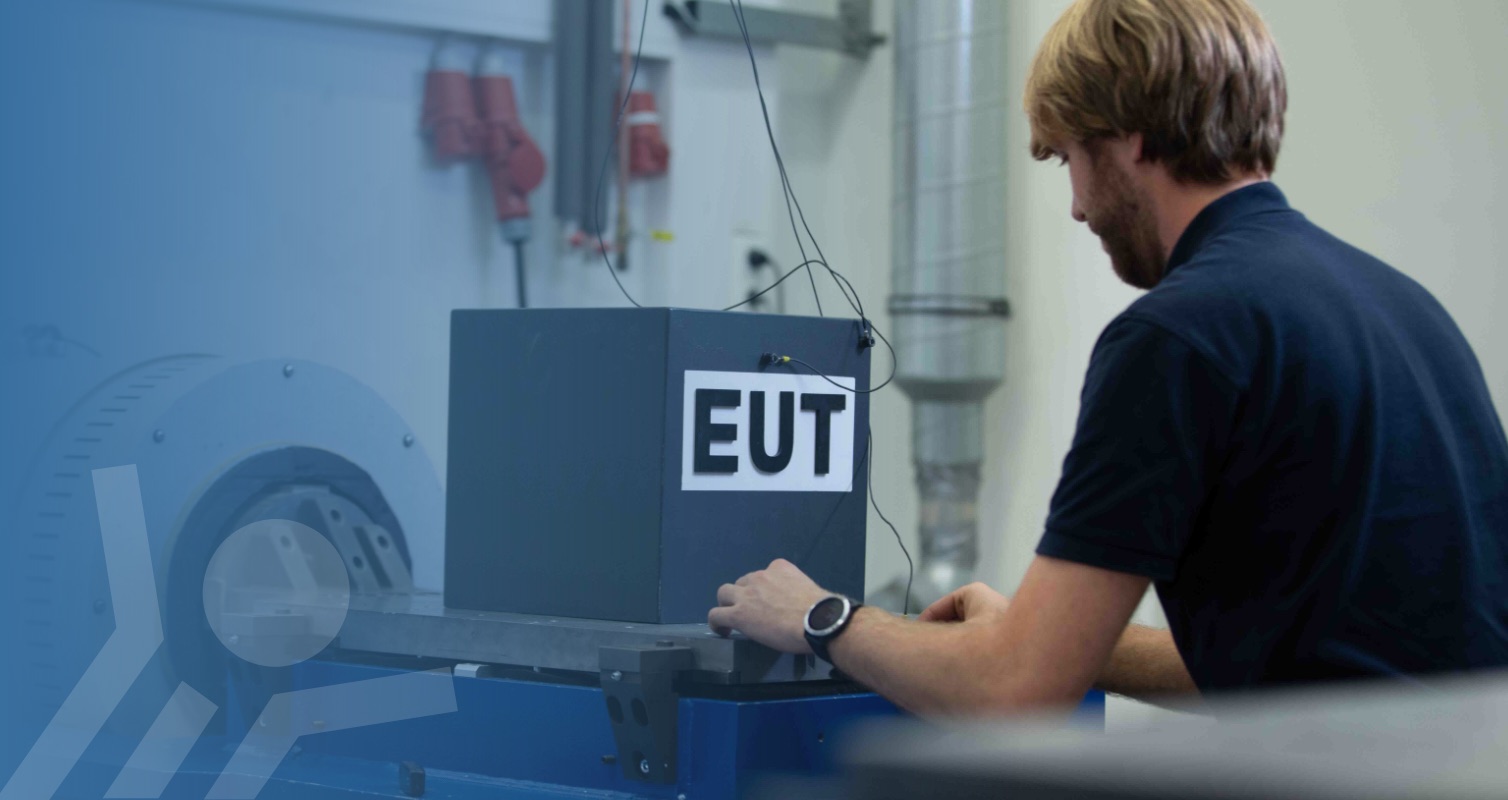
As a specialized provider of mechanical testing services, we conduct professional vibration and shock tests in our testing laboratory to ensure that your products function reliably even under high stress and extreme environmental conditions. Whether during transport, in industrial applications, or in safety-critical areas, mechanical stresses such as vibrations and shocks can lead to premature failure.
Our tests simulate these real-world stresses and provide you with clear insights into your product’s strength, durability, and quality reserves..
Why vibration and shock testing are essential
Throughout their entire lifecycle, products are subjected to various mechanical stresses. These stresses can be caused by machinery, motors, external environmental factors, or packaging during transport. Our tests help you identify and address critical issues as early as the development phase.
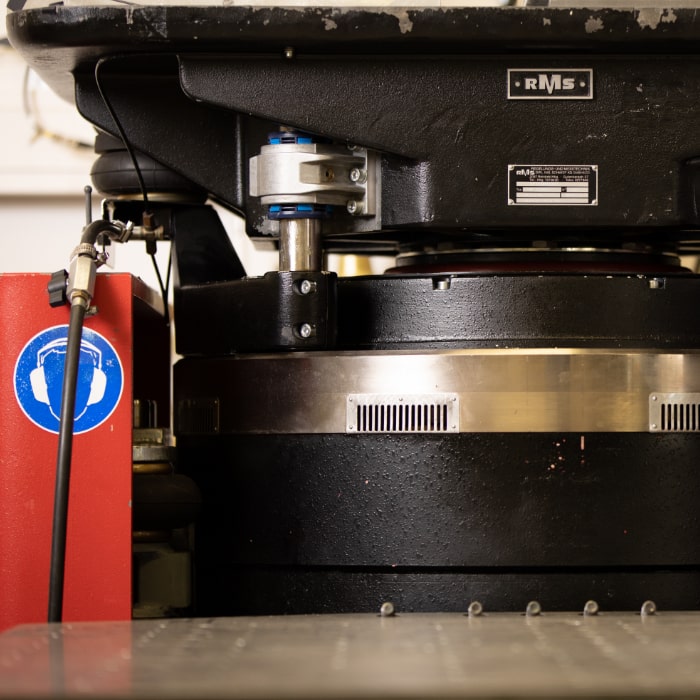
In everyday use, these tests are also known as “vibration and shaking tests”—conducted on modern shakers that generate precise vibration profiles.
Your benefits:
- Safety & Reliability:
By conducting tests in accordance with industry standards, we ensure that products remain functional even under extreme conditions - particularly in the aerospace, defense, automotive, medical technology, and renewable energy sectors. - Early detection of vulnerabilities:
Vibrations can cause material fatigue, cracks, or loose connections. Shocks can damage components or completely disable systems. Our tests reduce the risk of premature failure. - Cost optimization:
Vulnerabilities are identified long before they lead to costly recalls, service costs, or downtime. - Compliance with international testing standards:
We conduct testing in accordance with globally recognized standards such as DIN, ISO, IEC, and MIL-STD-810, including the analysis of frequency spectra and realistic stress profiles. We guide you through the entire process of applying and interpreting the relevant testing standards.
An Overview of Our Services
- Sine vibration tests:
Simulation of defined vibrations within a clearly defined frequency range. - Random vibration tests:
Realistic simulation of random, broadband vibrations—particularly important for transportation and operational environments. - Sine on random:
Superimposition of sinusoidal oscillations onto a random signal for detailed stress analyses. - Random on random:
random load multiple profiles for particularly realistic test conditions. - Shock tests:
Simulation of sudden events such as shocks or impacts—essential for evaluating product stability and structural strength.
Customized test fixtures for maximum test quality
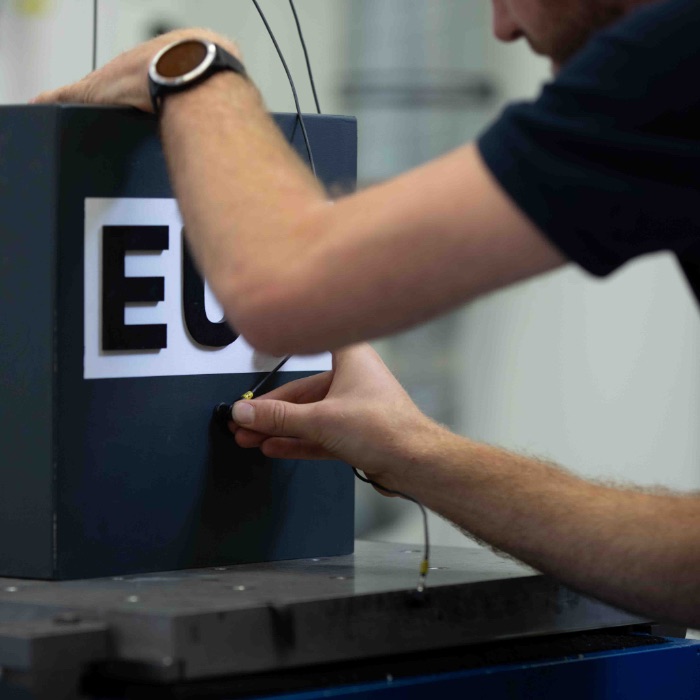
To ensure optimal test results, it is essential that your test specimen is mounted securely and in a manner that accurately reflects real-world conditions.
We develop custom adapters using our in-house 3D CAD workstation and manufacture them directly in our workshop or through specialized suppliers. This allows us to test your product under conditions that precisely match its intended use, design, and real-world stresses.
The standards and procedures in this area include the following:
- DIN EN-60068-2-6 Test Fc: Vibration (sinusoidal)
- DIN EN-60068-2-64 Test Fh: Vibration, broadband random and guidance
- MIL-STD-810 Vibration, Mechanical Vibrations of Shipboard Equipment (Type I - Environmental and Type II - Internally Excited)
- RTCA DO-160 Vibration
- DNV-CG-0339 Vibration tests
- DIN EN 61373 Railway applications - Railway rolling stock equipment - Tests for vibration and shocks
- DIN EN 60945 Vibration (all appliance classes)
FAQ
What is the difference between shock and vibration testing?
Shock and vibration tests simulate different types of mechanical stress. Vibration tests generate continuous or random oscillations over a specific frequency spectrum. They show how a product reacts to long-term, recurring loads—such as during transport or operation—and reveal resonances, material fatigue, or loosening. Shock tests, on the other hand, simulate very short, high-energy pulses such as impacts, drops, or hard collisions. They assess whether a product can withstand sudden extreme loads without loss of function or structural failure. Both types of testing complement each other to evaluate the overall robustness of a product.
How is a shock test performed?
A shock test is conducted to verify how robust a product is against sudden and short-term loads. During the test, the specimen is mounted on a shaker, a special shock machine, or a drop tower. These devices generate defined impact pulses, usually with very high acceleration peaks and very short durations. The shape of the pulse—e.g., half-sine, trapezoidal, or rectangular—is determined according to the applicable test standards. During and after each shock, mechanical and functional changes are checked to detect potential damage, failures, or structural issues. This ensures that the product can survive real-world extreme events undamaged.
What is a mechanical shock test?
A mechanical shock test is a testing method that evaluates a product's resistance to sudden, short-term loads. It involves applying very rapid acceleration pulses to the specimen, such as those that can occur during drops, impacts, proximity to explosions, or abrupt movements. The impact loads usually last only a few milliseconds but generate high forces that can lead to structural failure, cracks, or functional malfunctions. A shock test simulates such real-world extreme events under controlled laboratory conditions to check if a product is robust enough and maintains its full functionality after each shock.
Which norms and standards exist for shock tests?
There are several internationally recognized standards for shock tests that define testing conditions, pulse shapes, and evaluation procedures. Particularly relevant is MIL-STD-810, the military environmental test standard with detailed specifications for mechanical shock loads. Also important are DIN EN 60068-2-27 and IEC 60068-2-27, which define shock tests for industrial and electronic products.
What is a vibration test?
A vibration test is a testing method used to evaluate how a product responds to continuous, repetitive, or random vibration loads. To do this, the test specimen is mounted on an electrodynamic or hydraulic shaker that generates controlled vibration profiles. These profiles can be sinusoidal, random, or a combination of both, and cover various frequency ranges. Vibration tests simulate transport loads, machine-induced vibrations, or operational environmental influences. The goal is to identify resonances, material fatigue, loosening, and potential weak points at an early stage to ensure the product’s reliability and strength throughout its entire lifecycle.
What is the purpose of vibration testing?
Vibration testing is used to evaluate a product’s durability and operational reliability under realistic vibration loads. During use, a product is often subjected to continuous vibrations—for example, in vehicles, on machinery, in aircraft, or during transport. The test reveals whether components could be damaged by resonance, screws could come loose, circuit boards could break, or electronic components could fail. By analyzing the entire frequency spectrum, critical areas can be identified early on. In this way, the test supports the optimization of design, strength, and construction and minimizes the risk of field failures or malfunctions.
What standards exist for vibration testing?
There are numerous established standards for vibration testing that define test profiles, frequency spectra, and evaluation methods. DIN EN 60068-2-6 (sinusoidal) and DIN EN 60068-2-64 (noise) are particularly widespread. In addition, IEC 60068 specifies globally applicable test procedures for electrical and electronic products. In the military sector, MIL STD 810, particularly the methods for sinusoidal and random vibration, is the authoritative standard. In the automotive industry, ISO 16750 or manufacturer-specific standards are frequently used. These standards ensure that vibration tests are conducted in a reproducible, realistic, and internationally comparable manner.

contact us
Contact us directly or leave us a message.
We are happy to advise you!

Head of Environmental
Simulation Laboratory
Till Schwermer
Dr.-Ing.
Testing? Treo
ENVIRONMENTAL SIMULATION
Testing areas: